


 All masks
 Original masks
 Special edition masks
 Eyelash-protecting masks
 Featherweight masks
 Breakfast at Drowsy
 Sleep and the City
 Pillowcases
 Weighted blankets
 Bundles
 Gift sets
 Gift card
 Gift guide
 Bridal
 All travel accessories
 Necessaire
 Weekend bag
 Carry pouches
 Caps
Caps
 Pillow spray
 Candle
 Body care
 Supplements
 Scrunchies

What are the different types of colored noise, and which one is best for sleep
If you've ever played rain sounds or that low fan hum just to help yourself drift off, you've already used colored noise without realizing it. A lot of us do this, sometimes without thinking too hard about why it works. You just know that when your room is too quiet or your noisy neighbors are too unpredictable, your brain refuses to settle. And suddenly, the soothing sound of steady rain feels like the only thing keeping you sane.
That's basically what colored noise is. Different textures of sound, built from different frequency patterns. Some sharper, some softer, some almost too quiet to notice until you turn them off. And choosing one isn't about being scientific, really. It's about noticing what your brain calms down to.
What "colored noise" actually means
Colored consistent background noise is just a way to describe how sound energy is spread across the sound spectrum. It sounds complicated, but the idea is straightforward. Each "color" emphasizes certain frequencies differently.
So white noise hits every audible frequency at the same intensity. It has that static-like feel. Pink noise trims off some of the sharper edges. Brown noise goes even deeper; more rumble, less hiss. You might hear it and think of a deep fan, or something like a soft thunder roll that never peaks. Once you notice these differences, you can't un-hear them.

The main types of colored noise
White noise
White noise gives equal weight to all frequencies, which is why it sounds like a steady hiss. Almost sterile. Fans, air conditioners, and radio static. It works because it covers up unpredictable sounds, the kind that get under your skin, like a door shutting or a neighbor walking around above you. If you're a light sleeper, this is often the first one people try.
Pink noise
Pink noise softens the high and boosts the lower frequencies. It ends up feeling warmer. Not "cozy," just easier on the ears. Like rain that doesn't change intensity or waves that roll the same way again and again.
Some studies suggest it supports deeper, more stable sleep. Hard to say whether that's universal, but many people prefer it because it blends into the room without calling attention to itself.
Green noise
Green noise sits somewhere between pink and white noise, but it leans toward calmer, mid-range frequencies. Some people compare it to a gentle outdoor sound; not quite waves, not quite wind, but something in that direction. It feels steady without being too heavy or too bright.
Brown noise
Brown noise (sometimes called red noise) goes lower still. Think rumbling thunder or a deep fan. It's heavier, but in a comforting way. You don't get that sharp edge that white noise sometimes has.
A lot of people who can't tolerate bright sounds settle here. If your neighborhood is noisy or your walls are thin, brown noise often does a good job at covering everything else up. Many people compare pink and brown noise, since both lean toward lower frequencies, but brown noise tends to feel heavier and more grounded.
Blue noise
Blue noise flips the structure. Higher frequencies dominate. It's punchier, and honestly, not something most people use for sleep. It can mask sharp external sounds, but for nighttime use, people often find it a bit too intense.
Violet noise
Even higher than blue. It's occasionally used for tinnitus masking because it focuses heavily on the upper end of the spectrum. For sleep, though, it's rarely chosen unless someone specifically likes that sharp top-end.
Gray noise
This one tries to match how the human ear actually hears things. It adjusts frequency levels so everything feels the same loudness. It doesn't sound like static; more like a neutral, balanced wash. You don't hear it often in apps, but some people swear it's the most natural of all the noise types.
So which one helps you sleep?
You'd think there would be a clear winner here, but there isn't. Sleep habits vary too much. Some people fall asleep instantly with white noise because it erases the chaos around them. Others can't stand it and move straight to pink or brown noise because it feels gentler.
As a broad pattern:
-
White noise helps mask unpredictable sounds
-
Pink noise feels softer and steadier
-
Brown noise covers low-level noises and creates a grounded atmosphere
Your brain decides what works, not the label.

How to add colored noise to your sleep routine
You don't need anything fancy to try this: just a sound app or a simple sound machine. Keep the volume low enough that you barely notice it after a few minutes. That's the goal. You want something that disappears into the room.
If your home gets loud with disruptive sounds at random hours, keep it on all night. If it's just mild settling-in noise you're trying to soften, you can experiment with timers.
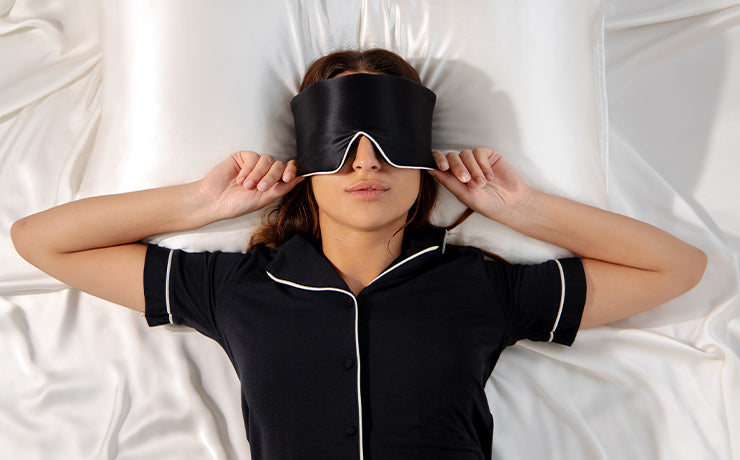
People sometimes pair noise with other comfort tools. Sleep masks, for example, help block light in the same steady way noise blocks sound. Same principle, just for your eyes. It creates a bedroom that doesn't argue with you while you're trying to settle down.
Where this leaves you
Colored noise feels technical, but once you try it, it's intuitive. White, pink, and brown—there doesn't have to be a "right" choice. Try a few sound frequencies with a sound machine. Rotate them. Change them depending on the night and your sleep quality. The aim isn't perfection, but finding the sound that finally lets your mind settle.
And if you want to go a step further, Drowsy's silk sleep masks pair well with any noise you choose. They keep your environment dark and calm, making whatever sound you pick feel even more consistent. Over time, that combination becomes a little nighttime ritual that helps you relax faster without overthinking it.


 United States (USD)